

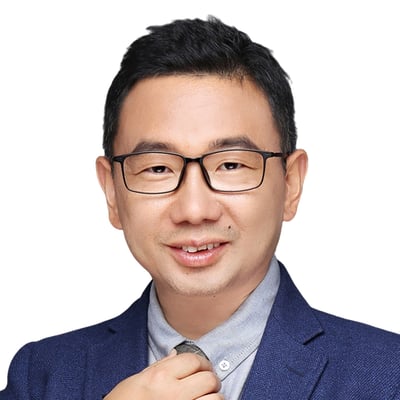
Dr. Yanan Wu
Founder & Chief Executive Officer
Surfin Meta Digital Technology Pte. Ltd.
Dr Wu is CEO and Founder of Surfin Meta Digital Technology (SMDT) Pte Ltd, a Singapore-headquartered financial technology solutions provider for the underserved.
He began his career as a research scientist in the IBM T. J. Watson Research Center as well as the Los Alamos National Lab, where he published several academic papers on first-rate physical journals.
Dr Wu then kickstarted his financial career by joining a hedge fund for quant trading, before moving on to TD Bank for 13 years as a senior portfolio manager, managing $30 billion in AUM for global asset allocation and quant strategies. Following that, he moved to Asia to join Citic-Prudential as Head of Quantitative Investment Director, and was responsible for managing $4 billion in AUM with a focus on Asian equities for 5 years.
SMDT was founded in 2017, inspired by Dr Wu’s passion for bringing financial inclusion to the unbanked and underbanked. He hopes to utilize his financial training combined with his love for technology to create a unique cross-border platform that will aim to provide financial services such as consumer lending and credit cards, payments and remittances, wealth management as well as B2B solutions to those who are unable to access traditional financial institutions.
Interventions lors du Sommet
-
1:30–3:00pmdim. 15 nov.RoundtableRoundtable 1Open
Chaktomuk - Rails Across Borders
Making Cross-Border Payments Work: QR, Remittances and Trade Settlement
À propos de cette session
Cross-border payments fail in different ways depending on the use case. QR payments may work domestically but stop at the border. Remittances can remain expensive even where digital channels are widely available. Trade settlement can still pass through third-country currencies and correspondent banks despite growing commercial links between emerging markets. The roundtable breaks the corridor problem into these separate channels and identifies what prevents each one from working today. It examines standards for extending QR interoperability, where remittance costs can realistically be removed, and what conditions are required for local-currency trade settlement.
-
3:30–5:00pmdim. 15 nov.RoundtableRoundtable 2Open
Phsar - Finance That Reaches People
The Missing Majority: Designing Finance for Informal Economies
À propos de cette session
Much of the world's workforce earns outside formal payroll systems. Income can arrive daily, seasonally or irregularly, while many savings, credit, pension and insurance products still assume a stable monthly salary. Informal workers are therefore not a marginal customer segment; in many emerging markets they are the economy's centre of gravity. Digital payments and alternative data have made it possible to build financial histories for people previously invisible to formal institutions, but access alone does not guarantee trust or sustained use. The roundtable compares products and distribution models designed around irregular income and asks what makes an informal worker continue using a formal financial product after the first transaction.

