
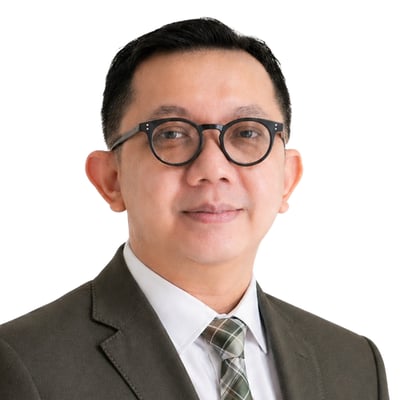
Aries Setiadi
Sr. Principal FSP & Policy Advocacy
Women's World Banking
Aries Setiadi is the Senior Principal FSP & Policy Advocacy at Women’s World Banking. He brings over 17 years of experience working across government, financial sector policymaking, and the financial technology industry.
Aries previously served as Executive Director at the Indonesia FinTech Association (AFTECH), where he led evidence-based policy advocacy with financial regulators and coordinated financial inclusion and financial literacy initiatives in partnership with academic institutions, international organizations, and civil society organizations. Earlier in his career, Aries spent more than a decade at Indonesia’s Ministry of Finance, where he worked on financial system stability, fiscal policy, and budget formulation. He coordinated cross-agency financial stability assessments, contributed to national economic recovery policies, and delivered macroeconomic and policy analysis.
Aries holds a Master of Public Administration from Columbia University’s School of International and Public Affairs (SIPA).
Interventions lors du Sommet
-
9:55–10:35amdim. 15 nov.Forum StageMain StageOpen
Phsar - Finance That Reaches People
Beyond Access: Turning Digital Finance into Financial Resilience
À propos de cette session
Opening an account is not the same as becoming financially secure. A household can have digital payments and still be one illness, failed harvest or income shock away from expensive debt. The next test for financial inclusion is therefore not simply whether people enter the financial system, but whether the system helps them withstand disruption and recover. Digital payment histories can support savings, credit and insurance for people with little formal financial history, while partnerships between banks, microfinance institutions and fintechs can extend services beyond traditional customer bases. The panel examines what resilience looks like in practice and which products, data models and partnerships measurably improve financial security for informal workers, women and small businesses.
-
3:30–5:00pmlun. 16 nov.RoundtableOpen
Chaktomuk - Rails Across Borders
From Bilateral Links to Regional Networks: Connecting Financial Ecosystems at Scale
À propos de cette session
Bilateral payment links can prove that cross-border interoperability works, but each new connection also adds another set of agreements, standards and supervisory relationships to maintain. At some point, adding country pairs one by one becomes less efficient than building a common network. Regional and multilateral initiatives are testing that alternative through shared platforms and settlement layers. The roundtable examines when bilateral connectivity should give way to multilateral architecture, how such systems should be governed and what individual countries must retain control over when infrastructure becomes shared. It closes by identifying the smallest credible cross-regional network that could demonstrate the model in practice.

