
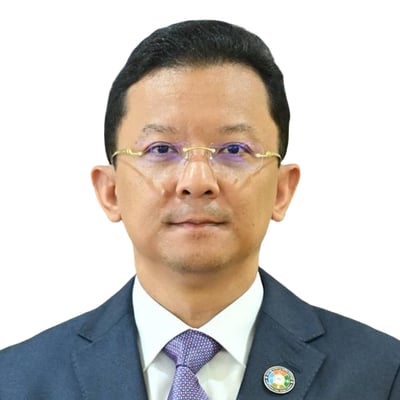
H.E. Hem Vanndy
Minister of Industry, Science, Technology & Innovation
Kingdom of Cambodia
HEM Vanndy
Minister
Ministry of Industry, Science, Technology & Innovation (MISTI)—Cambodia
______________________________________________________________
Mr. HEM Vanndy’s career spans across the private sector, the United Nations system, multilateral development bank and government. He is the Minister of MISTI, and concurrently chairs the National Council of Science, Technology & Innovation, the National Council of Standards, and National Council of Accreditation of Cambodia. He also chairs the Board of Trustees of Khmer Enterprise and the National Research Foundation and serves as a member of the Supreme National Economic Council.
Prior to his appointment as Minister of MISTI, he served as Secretary of State at the Ministry of Economy and Finance, looking after development financing, coordination and management of official development assistance, public debt management and supporting Cambodia’s key policy agenda. He was former Chair of the Country Coordinating Committee for the Global Fund program to fight AIDS, Tuberculosis and Malaria. In his early career, he was auditor at PricewaterhouseCoopers, national officer at UNFPA, and country officer at the Asian Development Bank—Cambodia Resident Mission.
He obtained his Mid-Career Master of Public Administration (Mason Fellow) from Harvard Kennedy School of Government, Master of Arts in International Development from International University of Japan, and Bachelor of Business Administration from then National Institute of Management (Cambodia). He is married with two daughters.
Speaking at the summit
-
9:05–9:10amSun 15 NovForum StageMain Plenary StageOpen
Others
Ministerial Remarks: MISTI
About this session
Nine centuries ago, long before invention became the privilege of a few wealthy economies, Khmer engineers built the hydraulic network that made Angkor the largest pre-industrial city on Earth. That privilege is eroding. A country unburdened by legacy infrastructure can now outpace those still carrying it, as Cambodia showed by leapfrogging to national-scale digital payments in under a decade. The remarks ask what it takes for ideas to move from the laboratory into the real economy across the emerging world, from enabling regulation to capital, skills and early adoption, and why a population with a median age of 26 makes Cambodia a live proving ground for what gets built.

