
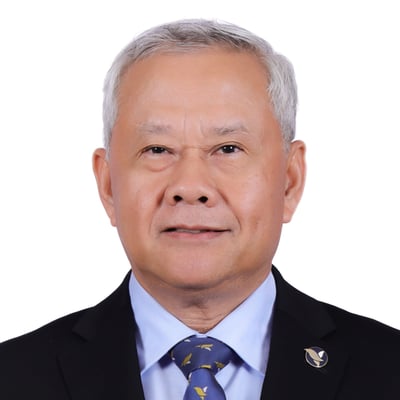
Dr. In Channy
President & Group Managing Director
ACLEDA Bank Plc.
Dr. IN Channy,
"President & Group Managing Director of ACLEDA Bank Plc., is a Shareholder representative for ACLEDA Bank Plc., ACLEDA Bank Lao Ltd. (ABL), ACLEDA Securities Plc. (ACS), ACLEDA MFI Myanmar Co., Ltd. (AMM), and ACLEDA University of Business (AUB), and Chairman of Boards of ACLEDA Bank Lao Ltd., and ACLEDA MFI Myanmar Co., Ltd. Besides ACLEDA Bank Plc., he is a Chairperson of ACLEDA Financial Trust (AFT), and one of the Board members of Cambodia Development Resource Institute (CDRI).”
Speaking at the summit
-
11:00am–12:15pmSun 15 NovGFTN BoardroomVIP&Speaker Lounge BoardroomInvite-Only
Others
Acleda Bank: From Connectivity to Commerce: Making Cross-Border Payments Work for Consumers and Businesses (Closed Door)
About this session
ASEAN has made progress connecting payment systems and schemes. The next challenge is to convert those connections into reliable, affordable and frequently used services for consumers, merchants and businesses. That requires more than technical connectivity: it requires aligned rules, clear accountability, workable economics, customer confidence and use cases that justify the effort of scaling.
Drawing on ACLEDA Bank's experience with cross-border QR and Bakong, this boardroom brings bank leaders, scheme operators, regulators and payment networks together to test where connections still fail across the transaction lifecycle, what turns a working link into a habit for consumers and merchants, and which business payment corridors are practical enough to pilot. -
1:30–3:00pmSun 15 NovRoundtableRoundtable 1Open
Chaktomuk - Rails Across Borders
Making Cross-Border Payments Work: QR, Remittances and Trade Settlement
About this session
Cross-border payments fail in different ways depending on the use case. QR payments may work domestically but stop at the border. Remittances can remain expensive even where digital channels are widely available. Trade settlement can still pass through third-country currencies and correspondent banks despite growing commercial links between emerging markets. The roundtable breaks the corridor problem into these separate channels and identifies what prevents each one from working today. It examines standards for extending QR interoperability, where remittance costs can realistically be removed, and what conditions are required for local-currency trade settlement.
-
9:10–10:00amMon 16 NovForum StageMain Plenary StageOpen
Chaktomuk - Rails Across Borders
The Corridor Economy: Connecting Payments Across Borders
About this session
Cross-border connectivity becomes real only when it solves a specific economic problem. Workers need cheaper remittances. Travellers need payments that work across borders. Small businesses need trade settlement that does not depend on multiple intermediaries. Connecting Southeast Asia and African markets therefore starts not with technology, but with choosing the first flow worth connecting. Cambodia's expanding cross-border payment relationships offer one starting point for that discussion. The panel examines which use case should come first, which existing systems can be connected rather than rebuilt, and who should absorb the cost and risk of creating the first viable corridor before transaction volumes are large enough to sustain it.

